
Table of Contents
Why 3D Architectural Models Are Becoming Essential in Modern Design Workflows?
There was a time when design approvals depended mostly on drawings, mood boards, and a bit of imagination. Architects would explain spaces using plans, sections, and elevations, and clients would try to picture how everything would come together in real life. Sometimes it worked. Sometimes it didn’t, and those “didn’t” moments usually showed up late, when changes were expensive.
That’s one of the biggest reasons 3D architectural models have become standard across modern architecture and construction workflows. They don’t just make projects look good. They help people understand design decisions before anything is built.
Across projects using 3d architecture modeling services, teams are seeing faster approvals, clearer client communication, and fewer last-minute revisions. And honestly, it makes sense. Most people don’t naturally think in plans and sections. But almost everyone understands space when they can see it in three dimensions.
In markets like the USA, UK, and Europe, where client expectations are high and design competition is intense. Architectural 3D modeling has shifted from being a presentation tool to becoming part of the actual design process.
How 3D Architectural Models Improve Design Visualization?

One of the biggest advantages of architectural 3D modeling is clarity. Instead of explaining a space, you show it.
- With high-quality architectural 3d modelling services, architects can test proportions, lighting conditions, material combinations, and spatial relationships early in the design phase. Things that might look fine on a drawing sometimes feel very different in a 3D model. The ceiling might feel lower than expected
- Another important factor is design validation. Structural systems, MEP models, layouts, facade elements, and interior layouts can all be reviewed together. Instead of disciplines working in isolation, the model becomes a shared reference.
- For design teams, this reduces guesswork. For clients, it reduces anxiety. When clients can see how spaces connect, how light enters rooms, and how finishes interact, they become more confident in moving forward with approvals.
The Real Impact on Client Approvals and Stakeholder Confidence
Client approvals are rarely just about design quality. They’re about understanding risk.
When clients struggle to visualize a space, they often delay approvals. Not because they dislike the design but because they’re not fully sure what they’re approving. That hesitation can slow projects more than design changes ever do.
This is where architecture 3d models services make a noticeable difference.
3D walkthroughs, perspective views, and realistic visualization help clients see how the building will actually feel. For developers and real estate stakeholders, this also supports early marketing and investor presentations.
In many projects using architecture 3d modeling services, teams report shorter approval cycles simply because decision-makers feel more informed. The model answers questions before they’re asked.
This is especially important in complex projects like healthcare buildings, commercial developments, and mixed-use structures, where multiple stakeholders must agree before design moves forward.
Why 3D Architectural Models Reduce Design Rework?
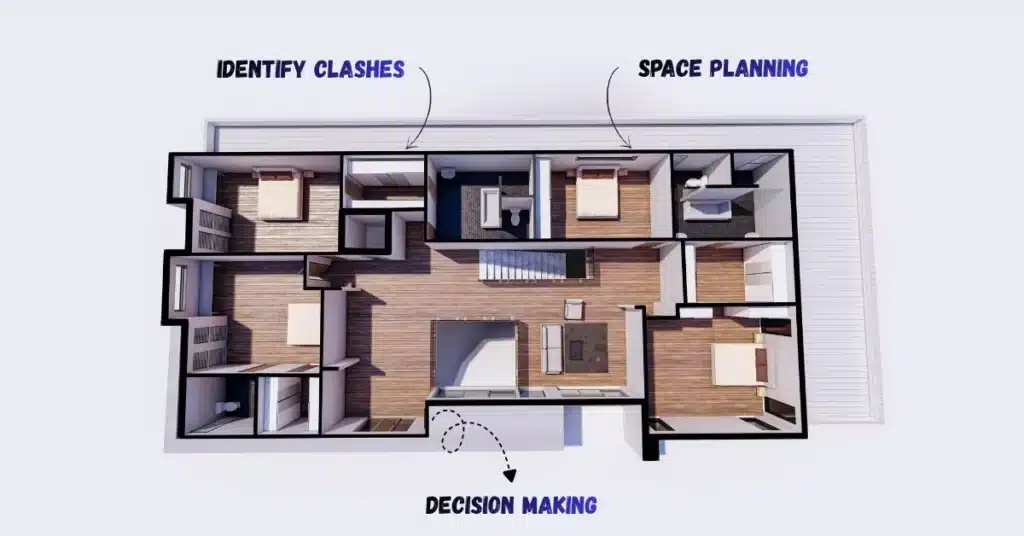
Rework usually happens when something looks acceptable in 2D but doesn’t work spatially in reality.
- 3D modeling services help identify conflicts between structure, architecture, and services early. For example, ceiling heights can be checked against duct routing. Window placements can be reviewed against structural framing. Interior layouts can be evaluated against real usable space, not theoretical dimensions.
- Across projects using architectural 3d modelling services, teams often notice fewer late-stage design changes. That directly impacts project cost and schedule stability.
- Another subtle benefit is internal team alignment. When everyone works from the same visual reference, misunderstandings reduce. Coordination meetings become more productive because discussions are based on shared visuals instead of separate drawing interpretations.
How 3D Models Support Better Communication Across Project Teams
Architecture today is rarely local. Design teams, consultants, and clients often work across cities or even countries. 3D architectural models create a common visual language. Instead of long explanation emails or marked-up PDFs, teams can review the same model and discuss real spatial conditions.
This becomes even more valuable in BIM-integrated workflows, where 3D models connect directly with technical data. Models can support design reviews, coordination workshops, and client presentations all at the same time.
For many firms offering 3D building models, this ability to support both design and communication is becoming the biggest value driver.
Also read: The Role of MEP Shop Drawings in Prefabrication and Modular Construction
The Growing Role of 3D Architectural Modeling in Competitive Design Markets?
In design-driven regions, presentation quality influences project success. Clients expect to understand projects visually before construction begins.
But what’s changing is that visualization is no longer separate from design development. It’s becoming part of how design decisions are tested and validated.
Architectural 3D models are now used for:
– Design reviews
– Planning approvals
– Client presentations
– Marketing and sales visualization
– Construction coordination support
For firms competing in high-value markets, strong visualization is no longer optional. It’s part of how projects move forward faster and with fewer misunderstandings.
Conclusion
The real value of 3D architectural models isn’t just visual quality. It’s decision clarity.
They help architects test design ideas earlier. They help engineers coordinate systems more accurately. They help clients understand projects without needing technical drawing knowledge.
Across projects using 3d architecture modeling services, the biggest improvements show up in faster approvals, fewer revisions, and stronger stakeholder confidence.
As buildings become more complex and project timelines become tighter, architectural 3D modeling is becoming less of a presentation tool and more of a core design and communication platform.
For design teams and clients alike, seeing the project clearly before construction begins isn’t just helpful anymore. It’s expected.
About Cresire Consulting
Cresire Consulting is a trusted global provider of BIM, CAD drafting, and architectural visualization solutions for the AEC industry. The company specializes in transforming complex design concepts into precise digital models that support better collaboration, faster approvals, and efficient project execution.
With expertise in 3D architectural modeling, Scan to BIM, and engineering documentation, Cresire helps architects, developers, contractors, and consultants improve design clarity and project decision-making through technology-driven workflows.
Frequently Asked Questions (FAQs)
1. What are 3D architectural models?
3D architectural models are digitally created representations of buildings or spaces that show accurate geometry, materials, textures, and spatial relationships, helping stakeholders understand designs before construction begins.
2. How do 3D models improve design visualization?
They provide realistic views, multiple perspectives, and detailed layouts that allow architects and clients to visualize structure, scale, lighting, and finishes more clearly compared to traditional 2D drawings.
3. Why do clients approve projects faster with 3D models?
Clients can easily understand design intent through realistic visuals, walkthroughs, and rendered presentations, reducing confusion and minimizing repeated revisions during approval stages.
4. Can 3D architectural models reduce project errors?
Yes. By identifying clashes, spatial conflicts, and design inconsistencies early, 3D models help teams resolve issues before construction, saving time and cost.
5. Who benefits the most from 3D architectural modeling services?
Architects, real estate developers, contractors, interior designers, and property investors benefit by communicating ideas clearly and making confident decisions.
6. Are 3D models useful for marketing and presentations?
Absolutely. High-quality 3D visuals and renderings enhance property marketing, investor presentations, and stakeholder meetings by showcasing projects realistically and engagingly.
7. How do 3D models support collaboration among project teams?
They create a shared visual reference that architects, engineers, and clients can review together, improving communication and coordination throughout the project lifecycle.

Devashish is Founder/Director at Cresire where he leads BIM services. He holds a bachelor’s degree in Civil Engineering from the University of Sheffield and an MSc in Construction Project Management from The University of the West of England. His vision behind CRESIRE is to provide BIM services, adhering to best practices and procedures, to global customers, helping customers to save extensive production costs and overruns.