

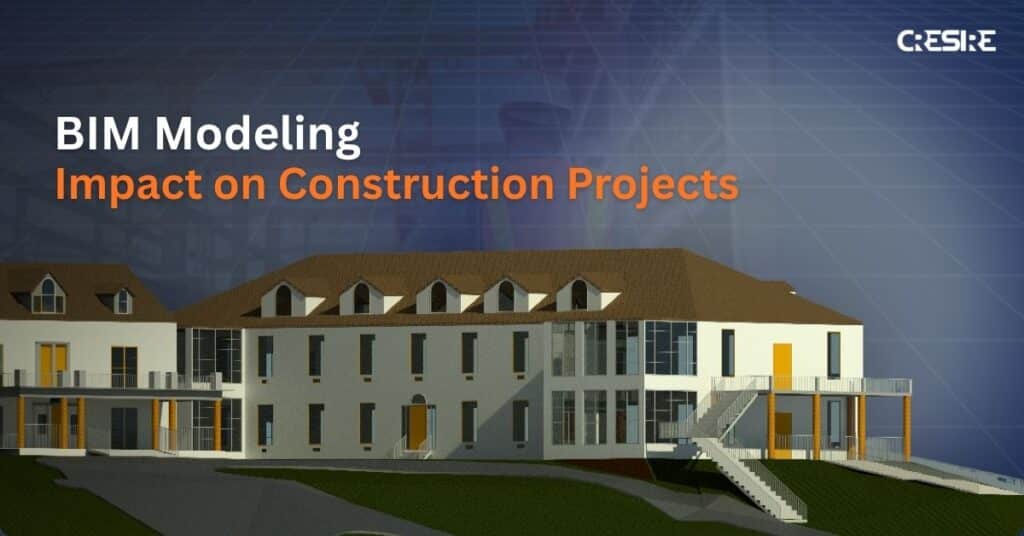
What is 3D BIM Modeling? (And Why It Matters More Today)
In its most basic sense, the creation of a 3D BIM model simply involves the creation of a three-dimensional digital model of the building. For those involved in architecture, engineering, and construction, however, the term “3D model” fails to do justice to the concept of 3D BIM modeling.
The BIM model goes beyond being merely geometrical in nature because the model contains information embedded within the geometrical representations. The wall, for example, contains information about the material used, thickness, fire resistance rating, and perhaps even the cost associated with each.
Software such as Autodesk Revit, 3ds Max, and SolidWorks can be utilized to create the models, although their functionality extends far beyond the capabilities of the programs themselves.
Whereas computer-assisted design (CAD) models serve primarily for representation, BIM models facilitate the comprehension of the building before it exists.
This seemingly small distinction is one of the key factors responsible for its increasing popularity among those in the AEC industry.

Why Revit 3D Modeling Has Become Essential in AEC Projects
There was a time when CAD drawings were enough. Plans, sections, and elevations told the story, and teams worked around them.
Today, that approach starts to break down. Projects are more complex. Coordination involves multiple disciplines working simultaneously. Timelines are tighter. And expectations around accuracy are higher.
3D BIM modeling solves problems by having one single cohesive model for all to refer to.
There is no need to interpret drawings differently as all parties are working within one virtual space.
You’re no longer asking, “Will this fit?”
You’re working with, “This is how it fits.”
Key Benefits of 3D BIM Modeling Services

1. Better Design Clarity (Not Just Better Visualization)
Yes, BIM models look better than 2D drawings—but that’s not the real advantage.
The real benefit is clarity.
In a BIM environment, you can:
- Understand spatial relationships instantly
- Review sections and elevations dynamically
- Visualize complex areas like MEP zones without guesswork
This reduces dependence on interpretation. Teams see the same thing—and that alignment matters more than aesthetics.
2. Improved Coordination Across Disciplines
Coordination problems constitute some of the major sources of delay and correction.
Using 2D processes, conflicts arising between architecture, structure, and MEPs usually go unnoticed until the start of construction.
3D BIM modeling avoids all that.
By working within a shared model:
- Conflicts are identified earlier
- Design adjustments happen before site execution
- Coordination becomes proactive instead of reactive
It doesn’t eliminate all issues but it removes the avoidable ones.
Top BIM service providers bring experience across tools like Revit, Navisworks, AutoCAD, and global compliance standards.
3. Higher Accuracy and Reduced Rework
One of the biggest advantages of BIM is accuracy.
Because models are built at real scale and include actual data, they reduce the chances of:
- Dimensional mismatches
- Incorrect assumptions
- On-site adjustments
And when changes do happen, they update across the model automatically.
That consistency saves time and more importantly, prevents costly rework.
4. Faster Decision-Making
In traditional workflows, decision-making often slows down because teams need to verify information. With BIM:
- Data is already embedded in the model
- Visual clarity reduces confusion
- Teams can evaluate options quickly
This becomes especially useful in design revisions, value engineering, or coordination meetings where time is limited.
5. Better Project Planning and Sequencing
3D BIM modeling also supports planning beyond design.
When combined with scheduling and sequencing, teams can:
- Visualize construction stages
- Identify potential bottlenecks
- Plan logistics more effectively
This improves not just design but execution.
Applications Beyond Architecture
While BIM is widely associated with design, its impact goes much further.

Health and Safety Planning
BIM models can help identify high-risk zones before construction begins. By analyzing site conditions digitally, teams can plan safer workflows and reduce on-site hazards.
Applications include:
- Hazard zone identification
- Access planning
- Temporary structure placement
This shifts safety planning from reactive to preventive.
Facility Management
Once a building is complete, the BIM model doesn’t lose its value.
Facility teams can use it to:
- Track assets
- Plan maintenance
- Manage building performance
Instead of searching through drawings, they can access information directly from the model.
Quality Control and Site Monitoring
With the integration of technologies like computer vision and scanning, BIM can also support:
- Progress tracking
- Quality verification
- Deviation analysis
This creates a stronger link between design intent and actual execution.
Role of 3D BIM in Sustainable Design
Sustainability is no longer optional—it’s a requirement.
3D BIM modeling plays a key role here by enabling early-stage analysis.
Models can be used to generate Energy Analysis Models (EAM), which simulate:
- Heat transfer
- Energy consumption
- Environmental performance
This allows engineers and designers to evaluate building performance before construction begins.
Instead of reacting to energy inefficiencies later, teams can design with sustainability in mind from the start.
Advanced BIM tools and experienced teams ensure high precision and fewer design conflicts.
From CAD to BIM: A Necessary Shift
AEC technology has evolved from hand drafting to computer-aided design (CAD) and, more recently, to Building Information Modeling (BIM). As noted in Wikipedia, each stage of this progression has improved efficiency and accuracy in design and documentation.
However, BIM represents more than just a technological upgrade. It marks a fundamental shift in how architecture and construction projects are approached.
Unlike traditional document-based methods, BIM is environment-based. It enables teams to develop a digital representation of the built environment, where models simulate real-world conditions and support better coordination, analysis, and decision-making throughout the project lifecycle.
Final Thoughts
The practice of utilizing 3D BIM modeling services has moved past being just nice to have.
It is now necessary for construction endeavors that require high accuracy and efficiency in their procedures. Essentially, BIM means cutting down on uncertainty.
This means providing a better picture of what is being built and what potential issues could exist.
Construction involves so much money that even small errors can have disastrous effects on the outcome of a project.
Also read: Top 10 Benefits of Revit BIM Modeling Services for AEC Teams
FAQs
1. Why do project owners and building contractors prefer 3D BIM?
Owners and contractors use 3D BIM because it improves coordination, cost control, decision-making, and transparency. It also supports faster approvals and smoother execution across multiple stakeholders.
2. Can 3D BIM improve project cost accuracy?
Yes. 3D BIM provides precise quantities, material takeoffs, and coordinated models that help estimators create more reliable budgets and reduce unexpected costs during construction.
3. Is 3D BIM useful for renovation and retrofit projects?
Absolutely. For existing buildings, 3D BIM combined with laser scanning or point cloud data creates accurate as-built models, helping teams plan renovations with fewer surprises.
4. What industries benefit most from 3D BIM modeling?
Commercial buildings, residential developments, hospitals, airports, factories, data centers, chemical plants, and infrastructure projects all gain value from 3D BIM workflows.
5. What is the current AEC industry requirement for 3D BIM?
Today’s AEC market expects coordinated BIM models, clash-free design packages, accurate quantities, faster project delivery, and data-ready models for facility management after handover.
6. Does 3D BIM only benefit large projects?
No. Small and mid-size projects also benefit through better visualization, reduced mistakes, improved approvals, and more predictable costs.
7. How does 3D BIM help during construction execution?
Site teams use BIM models to understand installation sequencing, dimensions, access constraints, and coordination issues before work starts.