

Introduction
If you have ever been involved in construction and renovations work, you understand that tiny measurement mistakes can bring about bigger issues during the process. This means that an error of a few millimeters in your plan will require hours or even days of corrections on site. That is why architectural engineering construction firms have been adopting the point cloud to BIM.
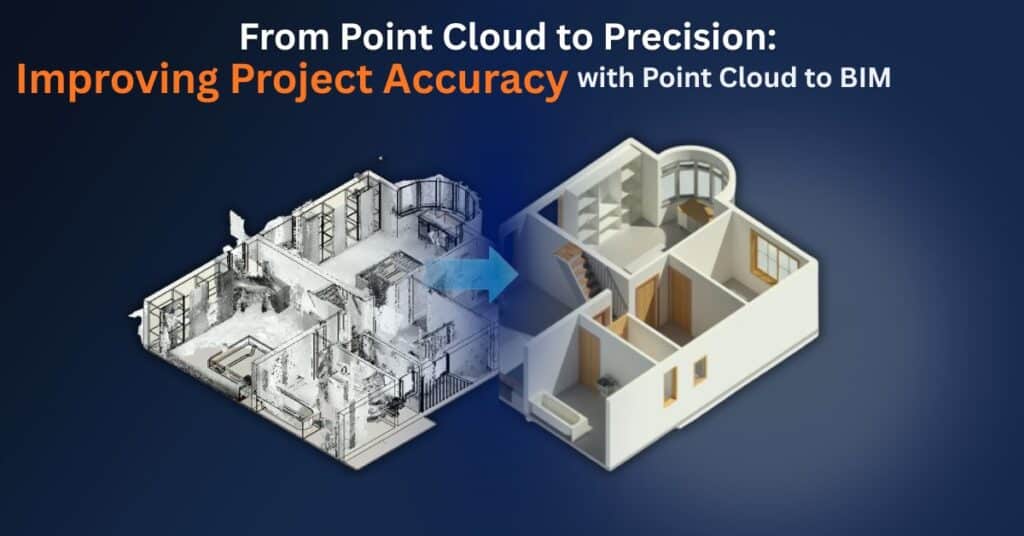
With point cloud to 3d model, you can create a representation of the site and its features in a digital format, turning them into models that can be edited using CAD software. The key advantage of the point cloud to BIM is not only the fact that you are capturing data but rather how well it can be captured.
What Point Cloud to BIM really means in practice
At a basic level, laser point clouds to BIM involves capturing site conditions that includes; exterior site, building elevations, architectural, structural & mep design elements and converting them into a digital 3D model.
These services are widely adopted mainly by architects & design studios, engineering consultants, and general contractors & developers.
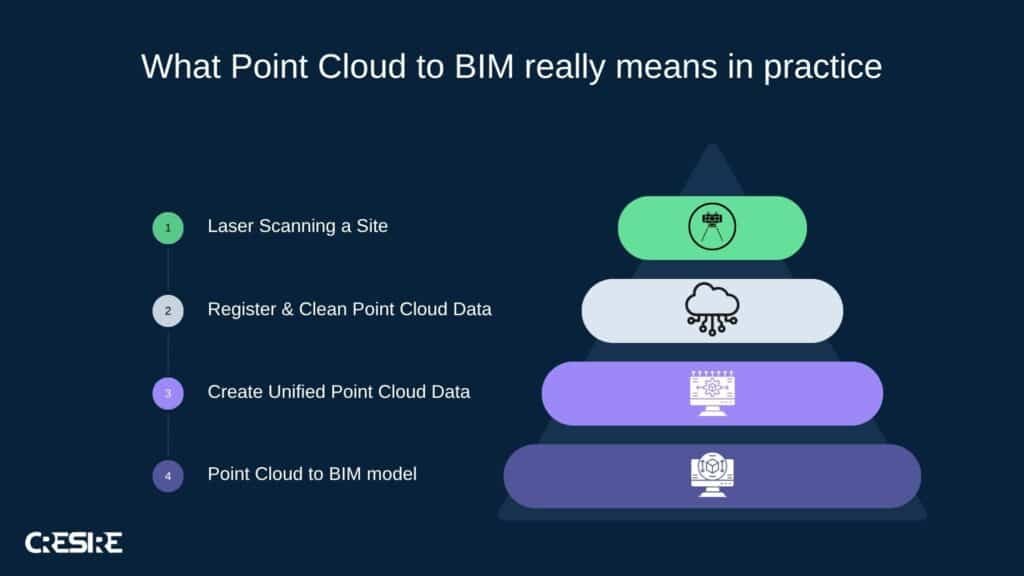
- Laser scanners collect millions of data points from a site, creating what’s called a point cloud.
- Laser surveying professionals clean, register and bind the point cloud data of a site to make it usable for BIM and CAD applications.
- Consequently, using advanced software like Autodesk Recap pro that point cloud data is processed and converted into a unified Recap file.
- Finally, the Recap file is finally used by BIM specialists for point cloud to bim applications
This sounds straightforward, but in practice, it’s not always that simple. Raw scan data can be messy. There can be gaps, overlaps, or misalignments. Turning that into a clean, usable BIM model requires experience, attention to detail, and most importantly, validation at every step.
Why accuracy still becomes a problem?
You would think that using advanced laser scanning technology would eliminate errors completely. Laser scanning reduces the problem but does not eliminate them completely. The issues usually show up later include:
- A beam is slightly off position in a building
- MEP elements do not align properly
- Site conditions do not match modeled assumptions
And when that happens, the cost isn’t just technical – it’s practical. Project stakeholders have to stop, reassess, and fix things that could have been avoided earlier.
That is why accuracy in Point Cloud into Revit is not just about scanning, it is about what you do with the point cloud data afterward.
Why Material validation matters in Point Cloud to BIM accuracy?
This is where integrating material testing workflows become useful. The inclusion of tested data and proper validation procedures makes an additional level of assurance when applying the model.
- The use of references to well-known practices, such as material testing processes, will allow the team to validate that what they have been modeling is reflective of reality.
- When BIM models are aligned with construction quality control standards, they become far more reliable. It is not just about geometry anymore; it is about whether the model represents something that can be built the way it’s intended.
- Using structured approaches, like those supported through established testing and inspection practices, helps teams maintain consistency across both digital and physical workflows.
Where Point Cloud to BIM Makes the biggest impact!

You will see the biggest benefits of Point cloud to 3D BIM in projects where accuracy is critical from the start. In AEC industry, different projects have different expectations from point cloud modeling process. Below are different scenarios where point cloud into revit makes the biggest impact:
- In renovation projects, existing structures rarely match their original drawings. Point Cloud modeling removes the guesswork by giving you a clear picture of what you’re working with.
- In industrial environments, where systems are tightly packed and highly coordinated, even small errors can cause major conflicts. Having an accurate BIM model upfront avoids a lot of back-and-forth later.
- In large infrastructure projects, where multiple stakeholders are working simultaneously, having a reliable digital reference point helps keep everyone aligned.
Challenges that still exist
Even with all its advantages, Point cloud into Revit is not without challenges. Handling large datasets can slow things down. Not every team has the expertise to interpret point cloud data correctly. And without a clear process in place, consistency can become an issue.
But most of these challenges aren’t about the technology, they’re about how it’s used. With the right workflows and validation practices, many of these issues can be managed effectively.
Looking ahead: What’s next?
As the industry moves forward, Point cloud into Revit is becoming part of something bigger, Digital Twins.
These aren’t just static models. They’re dynamic, constantly updated representations of real-world assets. And for that to work, accuracy becomes even more important than it is today.
In this context, the role of validation, testing, and reliable material testing equipment will continue to grow. The more accurate the input, the more useful the output becomes.
Final thoughts!
Point Cloud to BIM has changed how projects are planned and executed, but it’s not just about technology, it’s about trust in the data.
Accurate 3D BIM models do not happen by default. They come from combining good point cloud data capture with careful validation and practical workflows. When these components combine, it will give rise to a BIM model that would be practical for team members to use.
And when it comes to construction projects, reliability like this determines whether a job will be easy or difficult.

Author: Ryan Morrison
Ryan Morrison is the founder, owner, and chief marketing officer of Certified MTP. He is a quality engineering professional with more than two decades of experience in structured testing methodologies and validation systems. As the author of Certified Material Testing, he shares insights on quality planning, measurable testing frameworks, and risk-based assurance practices. Morrison is passionate about helping teams apply disciplined quality principles across industries to achieve consistent and reliable outcomes.