

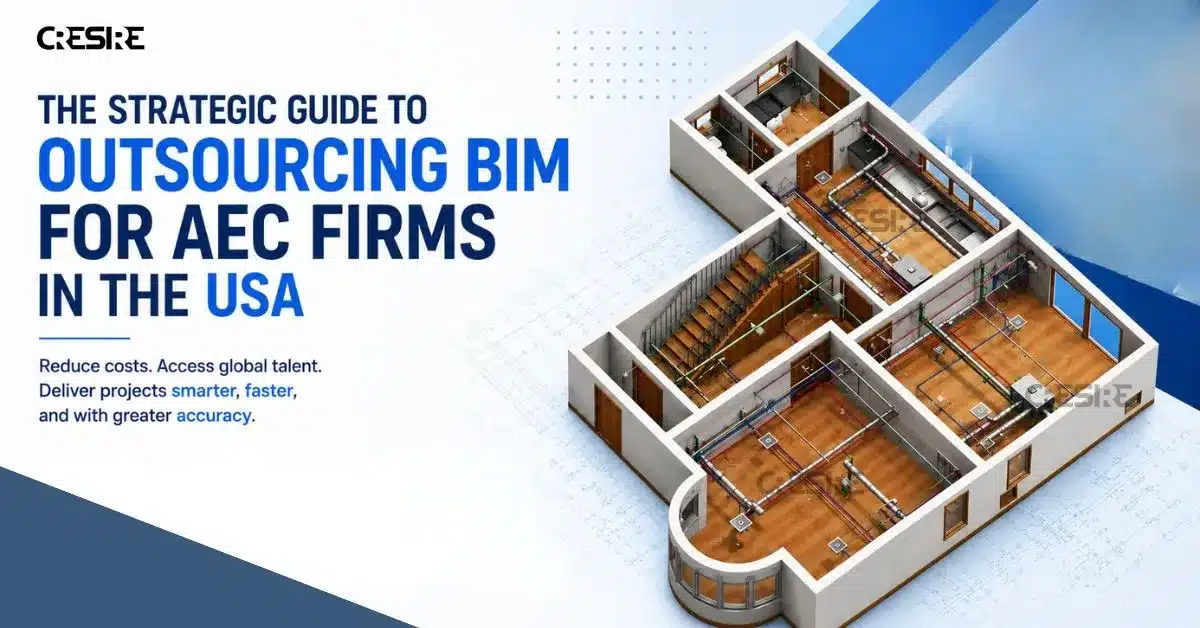
In many construction projects, the stumbling block to adopting the technology fully is not the foresight but the burden of overhead costs. Due to the unpredictability of projects, the increased price of software license fees, and the difficulty in recruiting skilled labor, the creation of a large BIM team may prove to be an expensive gamble.
That’s why there has been the rise of Outsourcing BIM. This time, however, it is more than delegating drafting services. It is a strategy to reinforce your manpower pool and ensure that you remain at the forefront of competition. Here’s how it works.
Understanding BIM Maturity: Beyond the "3D Model"
Before you outsource BIM, it is vital to speak the same language as your potential partners. BIM is often misunderstood as merely “3D modeling,” but for AEC professionals, it is a spectrum of data maturity:
- Level 0 (Conceptual): Moving from sketches to digital CAD. At this stage, you are establishing the footprint.
- Level 1 (Object-Oriented): The shift to parametric modeling (Revit). This is where most firms begin their BIM outsourcing journey by turning design intent into accurate, constructible models.
- Level 2 (The Collaborative Standard): This is where you integrate 4D (time/scheduling) and 5D (cost/estimating) data into your model within a Common Data Environment (CDE).
- Level 3 (Lifecycle Data): The “Gold Standard.” Here, the model isn’t just a design tool; it is a live, operational asset. If you are outsourcing BIM at this level, you are looking for data integrity and long-term facility management integration.
The Anatomy of a Successful Offshore BIM Partnership

If you are vetting partners, don’t look for a “vendor.” Look for an extension of your firm. When you are operating in the US market, the regulatory and construction standards are unique. A partner that doesn’t understand your specific regional requirements is a liability, not an asset.
Step 1: Audit Your BIM Expectations
Do not outsource building information modeling without a defined scope. Are you looking to mitigate clash detection issues, or are you trying to automate your 5D cost estimations? The methodology for a heritage retrofit is entirely different from a high-rise MEP coordination project. Define your “why” first.
Step 2: The "Leadership Vetting" Rule
This is the most critical step for any US-based firm. Many BPO (Business Process Outsourcing) companies have entered the BIM market as a “side hustle.” The Test: Look at the leadership team. Are they architects and engineers? Or are they just IT/business managers? If the people steering the ship don’t have boots-on-the-ground experience in construction management, they will struggle to bridge the gap between a “pretty model” and a “constructible model.”
Step 3: Aligning Data Environments
You aren’t just transferring files; you’re transferring project intelligence. Use tools like BIM 360 or Autodesk Construction Cloud as your shared language. If your partner is not comfortable working within your CDE (Common Data Environment), the “collaboration” will quickly devolve into a series of broken email threads and lost versions.Let’s be honest: half the “collaboration” in our industry is just passing around emails that nobody reads. Point cloud to BIM turns raw scan data into an intelligent, accessible model. When you upload this to a collaborative platform, the model becomes the conversation piece. Instead of writing long reports on design ambiguities, stakeholders can click on a specific element in the 3D model and tag the relevant person. It’s practical, it’s visual, and it cuts through the noise.
Why US Firms are Choosing Strategic Augmentation
The economic logic of the 2026 market is simple: Scalability.
- Talent Access: The US talent market is tight. Outsourcing BIM gives you immediate access to seasoned BIM technicians without the multi-month search for hires.
- Software Arbitrage: High-end BIM software is a massive line item. Partners who specialize in this absorb those licensing costs, allowing you to focus your capital on winning new business.
- Project-Based Agility: You should not have to carry the cost of a full BIM team during a lull in your project cycle. Outsourcing BIM allows you to ramp up capacity precisely when a large contract hits, and scale down just as easily.
A Note on the Tools for Offshore BIM
For your project to succeed, ensure your partner is natively fluent in the industry standard software ecosystem. While the “how” changes, the platform usually stays the same:
- Revit: The backbone of your architectural, structural, and MEP modeling.
- Navisworks: Your primary weapon for automated clash detection and construction simulation.
- ACC/BIM 360: The digital “central hub” that keeps your US-based lead team and your off-site partners synchronized.
Conclusion: Moving Beyond "Drafting"
The firms that get the most out of outsourcing BIM don’t view it as a transaction rather they view it as a partnership. By handing off the technical heavy lifting of model development to specialists, your team can return to the high-value work: design innovation, constructability planning, and client engagement.
At CRESIRE, we focus specifically on this partnership model. We aren’t just a BIM outsourcing company; we are a collective of architects and engineers who understand the technical demands of the USA construction market. Whether it’s complex MEP coordination or full-lifecycle BIM integration, we handle the data so you can focus on the design. If you’re ready to discuss how a strategic BIM partnership could streamline your next project, our team is ready to talk shop.
Share Via

Devashish Sharma
Devashish is Founder/Director at Cresire where he leads BIM services. He holds a bachelor’s degree in Civil Engineering from the University of Sheffield and an MSc in Construction Project Management from The University of the West of England. His vision behind CRESIRE is to provide BIM services, adhering to best practices and procedures, to global customers, helping customers to save extensive production costs and overruns.