

For a long time, architectural software conversations were fairly simple.
You either used CAD software for drafting or 3D software for visualization. Most workflows revolved around drawings, markups, PDFs, and manual coordination between teams.
That approach still exists in parts of the industry, of course. But the reality is that modern AEC projects have become far more connected and far more demanding than they were even a decade ago.
Today, architects aren’t just producing floor plans. They’re coordinating with structural engineers, MEP consultants, contractors, fabrication teams, and facility managers inside increasingly digital project environments. And because of that, architectural software is no longer just about drafting. It’s about information management, coordination, visualization, constructability, and collaboration across the entire project lifecycle.
What’s interesting, though, is that no single software platform handles all of this perfectly.
That’s why most architecture and construction firms across the USA, UK, Europe, and Australia now work within software ecosystems rather than relying on one standalone application.
And honestly, understanding how these tools fit into real-world AEC workflows is much more useful than simply listing software names.
CAD Software Still Plays a Bigger Role Than People Think
There’s a common assumption that BIM has completely replaced traditional CAD workflows.
Not really. Even in highly BIM-driven projects, CAD drafting remains deeply embedded within the industry. Many renovation projects, existing-condition documentation packages, consultant markups, and fabrication references still begin with 2D CAD environments.
This is particularly true in older cities like London or New York, where many buildings predate modern BIM standards entirely.
That’s why software like AutoCAD and AutoCAD Architecture continue to remain highly relevant in architectural workflows.
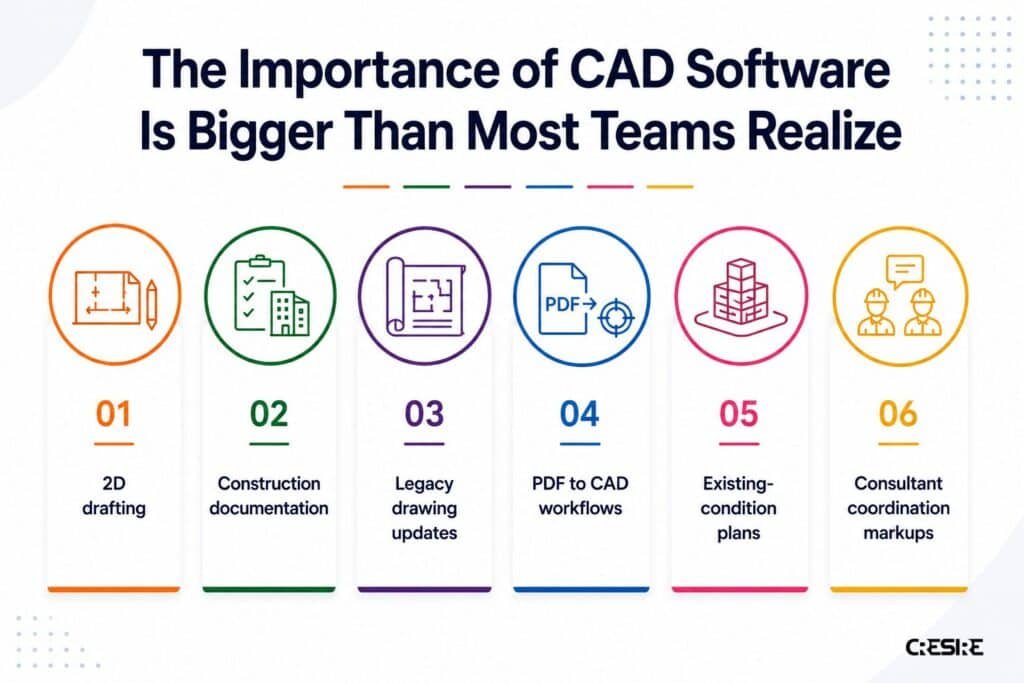
AutoCAD still dominates:
- 2D drafting
- Construction documentation
- Legacy drawing updates
- PDF to CAD workflows
- Existing-condition plans
- Consultant coordination markups
And while it may not carry the “future of BIM” excitement that newer platforms do, its flexibility keeps it deeply integrated into project delivery workflows across the AEC industry.
In many ways, CAD remains the foundation layer beneath larger BIM ecosystems.
BIM Platforms Changed How Teams Coordinate Projects
If CAD software helped digitize drafting, BIM software changed how teams coordinate buildings.
That’s really the major shift. Platforms like Autodesk Revit, Archicad, and Bentley’s MicroStation introduced something much bigger than 3D visualization. They created connected information environments where architecture, structure, MEP systems, quantities, and construction data could exist within coordinated models.
And as projects became more technically dense, that coordination became essential.
Healthcare facilities in the United States now involve highly congested MEP systems and strict compliance requirements. Infrastructure projects across the United Kingdom increasingly depend on BIM-based information management aligned with ISO 19650 standards. Industrial projects throughout Germany and other parts of Europe are becoming heavily fabrication-driven.
Traditional disconnected workflows simply struggle under that level of complexity.
This is where BIM software becomes valuable.
Using coordinated BIM environments, teams can:
- Identify clashes before construction begins
- Coordinate architecture, structure, and MEP systems together
- Generate more accurate quantities
- Improve multidisciplinary collaboration
- Support construction sequencing and prefabrication workflows
And perhaps most importantly, BIM allows teams to solve problems digitally before they become expensive site issues later.
That’s probably one of the biggest reasons BIM workflows are now central to modern project delivery.
Visualization Tools Are Becoming Part of Decision-Making
Architectural visualization has evolved significantly, too.
Years ago, rendering software was primarily used for client presentations and marketing images. Today, visualization tools often support actual project decision-making much earlier in the design process.
Software like SketchUp, Lumion, and Twinmotion allows teams to explore spatial relationships, lighting conditions, façade concepts, material studies, and user experience far more interactively.
And interestingly, these tools have become especially valuable in conceptual design stages where rapid iteration matters.
SketchUp, in particular, remains widely used because of its simplicity and accessibility. Many architects still use it for:

- Early-stage massing studies
- Concept development
- Interior visualization
- Client communication
- Quick design exploration
Meanwhile, real-time rendering platforms like Lumion and Twinmotion have changed expectations around project presentations entirely. Clients increasingly expect immersive visualization rather than static imagery alone.
The line between design software and communication software is becoming increasingly blurred.
The Rise of Reality Capture and Existing Condition Workflows
One of the biggest changes happening in architecture right now isn’t actually happening in drafting software.
It’s happening in reality capture.
As renovation, retrofit, and adaptive reuse projects continue growing across North America and Europe, firms are relying more heavily on laser scanning and point cloud workflows before design even begins.
That’s because existing buildings rarely match their original drawings perfectly.
Over time:
- renovations occur,
- systems get replaced,
- undocumented changes accumulate,
- and as-built conditions drift away from archived documentation.
This is where tools like Autodesk ReCap and scan-to-BIM workflows become increasingly important.
Laser scanning allows project teams to capture highly accurate existing conditions and convert them into:
- CAD drawings
- coordinated BIM models
- as-built documentation
- point cloud-based design references
And honestly, this workflow is becoming critical for renovation-heavy markets across cities like Amsterdam, Boston, and Melbourne where adaptive reuse and existing-building modifications are accelerating.
Before BIM coordination begins, teams first need confidence that the building data itself reflects reality accurately.
The Industry Is Moving Toward Connected Software Ecosystems
If there’s one major shift defining architectural software in 2026, it’s this:
- Projects are no longer built around isolated software tools.
- They’re built around connected workflows.
CAD software, BIM platforms, visualization tools, cloud coordination systems, reality capture platforms, and construction management environments now operate together within larger digital ecosystems.
And increasingly, the goal isn’t simply producing drawings anymore.
It’s creating reliable project information that supports:
- coordination
- construction planning
- prefabrication
- cost management
- facility operations
- long-term asset management
That’s why modern architectural software discussions are becoming less about “which software is best” and more about how different tools integrate across the project lifecycle.
Because in today’s AEC industry, software alone doesn’t define project success.Workflow connectivity does.
Share Via

Devashish Sharma
Devashish is Founder/Director at Cresire where he leads BIM services. He holds a bachelor’s degree in Civil Engineering from the University of Sheffield and an MSc in Construction Project Management from The University of the West of England. His vision behind CRESIRE is to provide BIM services, adhering to best practices and procedures, to global customers, helping customers to save extensive production costs and overruns.