Table of Contents
Introduction- Why Structural BIM Accuracy Matters?
Construction used to tolerate small uncertainties. If a beam shifted slightly or a slab thickness varied a little, teams solved it on site. Today, that margin is disappearing. Buildings are taller, structural systems are lighter but more complex, and prefabrication demands precision before materials even reach the project site.
The shift from 2D structural drafting to BIM workflows didn’t happen overnight. It happened because traditional drawings stopped carrying enough information. A 2D drawing can show a beam location, but it cannot easily show how that beam interacts with services, facade systems, or prefabricated structural components.
This is why Revit Structure Model Services are becoming central to modern construction workflows. Instead of relying on drawings alone, teams now work from intelligent structural models that support design validation, multidisciplinary coordination, and construction sequencing.
Across structural BIM modeling projects in the USA, UK, and Europe, model accuracy directly influences cost control, construction speed, and project risk. For first-time users of structural BIM services, the biggest realization is simple: the model isn’t just a visualization tool. It becomes the structural backbone of the entire digital project workflow.
What Revit Structure Model Services Actually Include?
Structural BIM modeling in Revit is essentially the process of building a digital structural twin of a building or infrastructure system. But in practice, it goes far beyond geometry creation.
- Most revit structural modeling services cover reinforced concrete structures, structural steel systems, precast components, foundation systems, and in some cases, reinforcement detailing and bar scheduling. The level of detail depends on project stage and final use case.
- What makes structural BIM different from traditional drafting is embedded intelligence. Structural elements carry properties such as material type, load behavior references, size parameters, and connection logic. This allows models to support quantity extraction, clash coordination, and sometimes even construction sequencing.
- In many structural BIM services workflows, the model becomes the single structural reference shared across architects, MEP engineers, and contractors. Instead of multiple teams interpreting drawings separately, everyone coordinates around one structural dataset.
For companies working across global markets like the USA, UK, and Europe, this shared structural model helps maintain consistency across distributed project teams and multi-phase construction programs.
What Lives Inside a High-Quality Structural BIM Model
A reliable structural BIM model starts with the core load-bearing system. This includes columns, beams, slabs, shear walls, trusses, and transfer structures. These elements define how loads move through the building and how construction sequencing must be planned.
Reinforcement modeling may be included for high-detail projects. In some structural BIM modeling services, reinforcement is modeled at fabrication-ready detail. In others, reinforcement is represented conceptually for coordination and design validation.
Foundation modeling is often underestimated. Foundations interact with soil conditions, existing utilities, basement structures, and sometimes existing building elements in renovation projects. High-quality structural BIM services model these relationships carefully because underground conflicts are expensive to resolve later.
Connection zones and coordination elements are equally important. Structural embeds, sleeves, penetrations, and support interfaces often determine whether coordination succeeds or fails. These elements rarely show up clearly in traditional drawings but become visible and manageable in BIM models.
How Revit Structural Models Are Built? - The Real Workflow
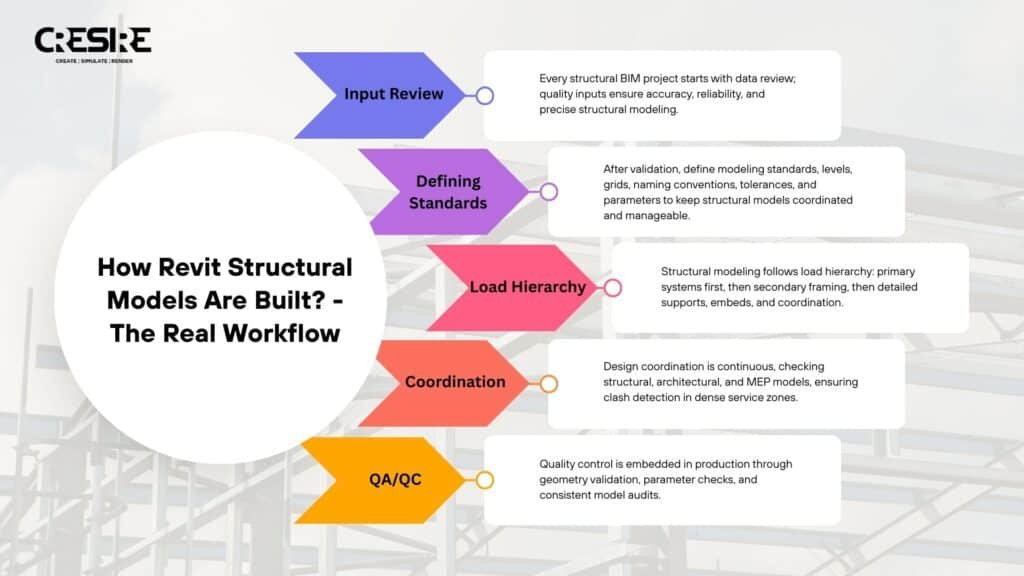
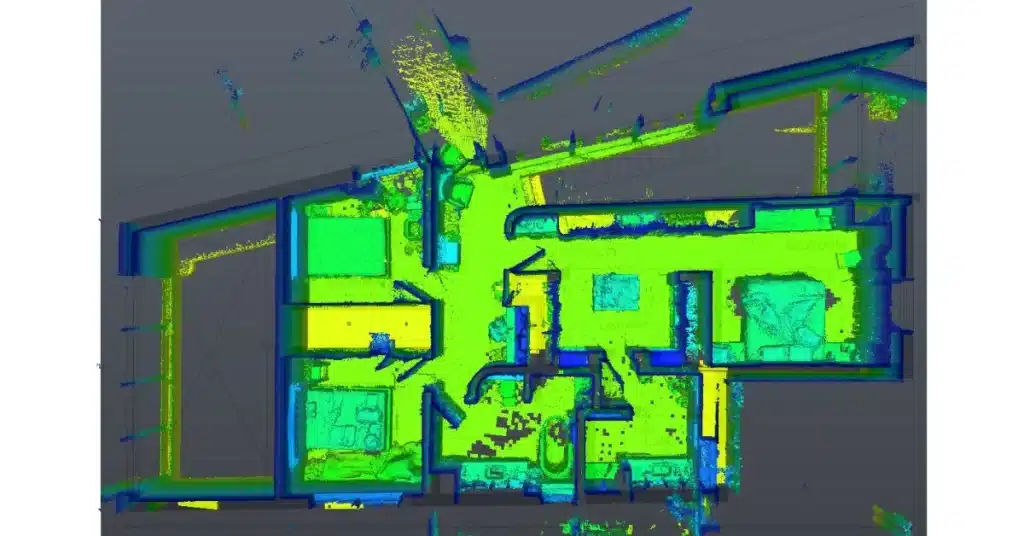
- Input Review: Every structural BIM project begins with input data review. This could include CAD drawings, IFC files, structural design models, or point cloud data from laser scanning. Data quality assessment is critical because structural modeling relies heavily on dimensional accuracy.
- Defining Standards: Once inputs are validated, modeling standards are defined. This includes level structures, grid systems, naming conventions, modeling tolerances, and parameter definitions. Without strong standards, structural models quickly become difficult to coordinate.
- Load Hierarchy: Structural modeling usually follows load hierarchy. Primary structural systems are built first. Secondary framing follows. Then comes detailing of supports, embeds, and coordination zones.
- Coordination: Design coordination is not a separate step. Structural models are continuously checked against architectural and MEP models. Clash detection is especially important in plant areas, ceiling zones, and high-density service corridors.
- QA/QC: Quality control runs throughout the process. Geometry validation, parameter checks, and model audit routines ensure consistency. Professional structural BIM services treat QA as part of production, not post-production.
Why Level of Development (LOD) Is Critical in Structural BIM?

LOD defines how detailed a structural model should be at each stage. Many first-time BIM users assume higher detail is always better. In reality, correct detail at the correct stage is what matters.
- LOD 200 typically supports early design validation.
- LOD 300 supports coordination and construction documentation.
- LOD 400 may support fabrication and installation planning.
In structural BIM modeling services, selecting the wrong LOD can create problems. Too low and coordination suffers. Too high and modeling becomes inefficient and expensive.
For prefabrication-driven projects, LOD directly impacts manufacturing confidence. Fabrication teams rely heavily on structural model accuracy. When LOD is defined correctly, prefabrication workflows become significantly more reliable.
Also read: PDF to CAD Conversion: 7 Mistakes That Lead to Wrong Drawings
The Real Benefits Of Revit Structure Model Project Teams Notice First
- The first noticeable benefit is improved design clarity. Structural engineers can visualize how systems interact spatially, not just theoretically.
- Multidisciplinary coordination improves significantly. Architects and MEP engineers work against real structural constraints rather than assumed conditions.
- Site rework reduces because conflicts are resolved earlier. Quantity take-offs become more reliable because model data links directly to material calculations.
- Decision-making speeds up. Project teams spend less time validating drawing assumptions and more time solving real design and construction challenges.
- Prefabrication support is another major benefit. Structural BIM services allow fabrication teams to work directly from coordinated digital models.
Why Companies Are Outsourcing Structural BIM Modeling in 2026
The demand for skilled BIM structural modelers continues to grow globally. Many companies struggle to maintain large in-house BIM teams while managing fluctuating project loads.
- Outsourcing allows access to experienced specialists, improves cost predictability, and supports fast project ramp-ups.
- Global collaboration tools now allow distributed BIM teams to work almost seamlessly.
Across structural BIM modeling markets in the USA, UK, and Europe, outsourcing is becoming a standard delivery model rather than an exception.
How Structural BIM Improves Construction Outcomes
If you speak to site teams after a project finishes, they rarely talk about models or software. They talk about how smoothly things went. Were there surprises during installation? Did the structure clash with services? Did sequencing make sense when steel started arriving or when concrete pours began? That’s really where structural BIM starts proving its value.
Structural BIM modeling shifts a lot of construction risk forward into the planning stage. Instead of discovering problems when materials and labour are already on site, teams can identify structural conflicts, access constraints, and sequencing issues while decisions are still relatively easy to change.
When 3D BIM modeling is built correctly, they don’t just show structure but they show how structure behaves in relation to real construction activities, temporary supports, installation clearances, and service integration.
Another practical advantage is communication. Site teams, consultants, and project managers can all reference the same structural model. That shared understanding removes a lot of back-and-forth that usually happens when teams rely on separate drawing interpretations. For owners and stakeholders, it also builds confidence because structural risks become visible early, not during critical construction phases.
When structural BIM is integrated properly into project workflows, improvements usually appear in several key areas:
- Better Construction Planning and Sequencing
Structural models help teams visualize construction stages. This supports planning for crane placement, material storage, temporary supports, and safe installation sequences, especially in complex or high-rise projects. - Improved Temporary Works Planning
Temporary structures like shoring, propping, and access platforms can be planned against real structural geometry. This reduces last-minute site improvisation and improves safety planning. - Reduction in RFIs and Site Clarifications
Coordinated structural BIM models reduce design ambiguities. When contractors can clearly see structural relationships with architecture and MEP systems, fewer RFIs are needed during construction. - More Reliable Installation Planning
Contractors use structural BIM models to plan installation paths, lifting sequences, and access routes. This is especially critical in high-density structural zones like plant floors, transfer levels, and basement structures. - Stronger Multidisciplinary Coordination on Site
Structural BIM models help align structural installation with MEP and architectural installation timelines. This reduces trade stacking and improves site productivity. - Early Identification of Structural Risks
Structural conflicts, load transfer complexities, and clearance issues become visible during coordination stages. This allows project teams to resolve issues before they affect schedule or cost. - Faster and More Confident Decision-Making for Stakeholders
Owners and project managers can review real structural scenarios instead of interpreting drawings. This helps speed up approvals and reduces hesitation during key project milestones. - Better Support for Prefabrication and Modular Construction
Accurate structural BIM models allow prefabricated elements to be manufactured with confidence, reducing site modification and improving installation speed.
Conclusion
If you step back and look at where construction is heading, one thing becomes very clear that reliable structural data is no longer a luxury. It’s becoming the baseline.
A well-built Revit Structure Model doesn’t just help engineers visualize structure; it helps entire project teams make smarter decisions earlier, when changes are still manageable and affordable.
Across modern Revit Modeling Services, the real value shows up quietly. Fewer coordination conflicts. Clearer installation planning. More reliable quantities. Better communication between design teams and site teams.
That’s why structural BIM services are becoming deeply embedded in project delivery across the USA, UK, and Europe.
For companies exploring revit structural modeling services for the first time, the biggest shift is mindset. The model isn’t just a digital drawing replacement, it becomes the structural reference that supports design, coordination, fabrication, and construction planning.
As projects become more prefabrication-driven and schedule-sensitive, structural BIM modeling is moving from being a technical upgrade to becoming a core part of how modern buildings are actually delivered.

Devashish is Founder/Director at Cresire where he leads BIM services. He holds a bachelor’s degree in Civil Engineering from the University of Sheffield and an MSc in Construction Project Management from The University of the West of England. His vision behind CRESIRE is to provide BIM services, adhering to best practices and procedures, to global customers, helping customers to save extensive production costs and overruns.
Our Recent Projects on BIM Services

Related Posts