Home / How Point Cloud to 3D Model in Revit Boosts Efficiency: A Technical Guide
- Cresire
- Point Cloud Modeling, Point Cloud to 3D Model
Read understanding of Point Cloud to 3D Model Conversion or Scan to BIM for Improved Efficiency. Know in detail here.
What is Point Cloud to 3D model Conversion in Construction?
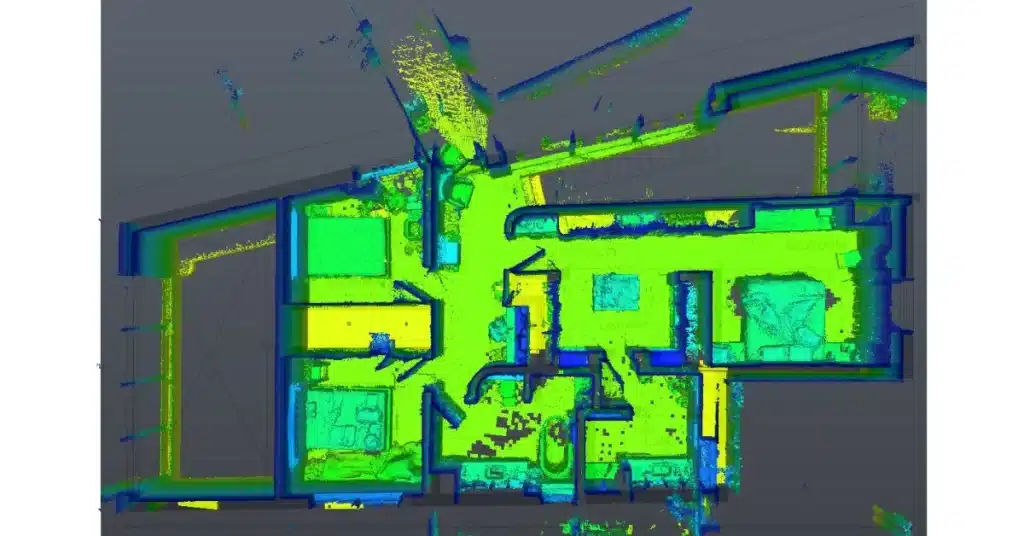
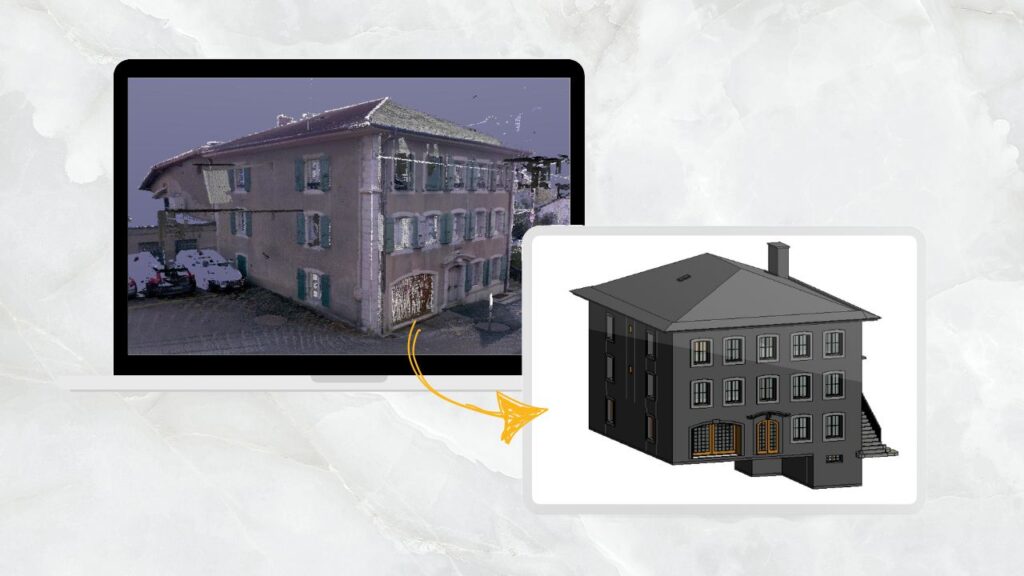
Point Cloud to 3D Model conversion is the most efficient way of converting any scanned laser image into editable 3D Revit models. The process begins with scanning and capturing the space in the form of point cloud data, a collection of data points containing all information like the coordinates, color, luminance, material and even time. The point cloud data is then processed and cleaned to be converted into 3D models using advanced software like Autodesk Revit. These sets of drawings/models can be seamlessly integrated into any construction workflow.
Creating 3D models from point clouds is widely used in today’s AEC industry in creating detailed BIM models for renovation, retrofitting, and planning, creating drawings for building layouting and design and even for site assessment and ongoing facility management.
In today’s rapidly evolving industry, scan to 3D model conversion quickly transforms any physical space into accurate data-rich digital models. This saves cost and time, makes real-world coordination easier, helps manage risk and safety throughout the project, gives more freedom to understand, design, renovate and long-term manage the existing building with reliable asset visualisation.
How Point Cloud to 3D model Conversion makes Renovation efficient?
Point Cloud 3D Models Conversion has made the process of renovation easier, accurate and precise. Advanced on-site scanning techniques like LiDAR (Light Detection and Ranging) or photogrammetry helps in accurate point cloud data collection, whereas advanced software like Autodesk ReCap cleans and processes the data and Autodesk Revit or AutoCAD converts it into detailed BIM models and 2D drawings. Even with such resources, a skilled professional is needed for scan alignment, noise filtration and accurate geometry reconstruction with functional details. Further, to ensure the best quality standards and level of detail required must be followed.
Renovation projects present their own set of challenges. Running facilities require non-intrusive scans to keep buildings functioning throughout while historical buildings require careful documentation of all intricate details without damaging any heritage. Multiple site visits and assessments can drain money, time and resources. Moreover, hidden MEP systems, irregular geometries, and structural variations increase complexity for the project and older buildings often lack drawings for reference. Renovation deals with handling, modifying and adding on to the pre-existing systems of the building, thus cannot be based on assumptions or old drawings.
- Scanned point cloud 3D models create as-built models of the existing that can provide detailed real-world geometries and functional information reducing design assumptions, supporting coordination, and helping stakeholders anticipate clashes and issues.
- A precise 3D model from point cloud data helps all the stakeholders involved understand and visualise the project better, plan modifications and streamline the process even before site work begins.
- With integrated BIM workflow, teams can accurately redesign the existing systems – architectural, structural and MEP while remaining within any spatial constraint. They can also stimulate timelines (4D) and costs (5D), manage materials and logistics while coordinating seamlessly. This helps minimize any errors and resource wastage while helping everyone take informed design for retrofitting, replacements, and long-term maintenance for any renovation process.
What is Point Cloud Data and How is it Used?
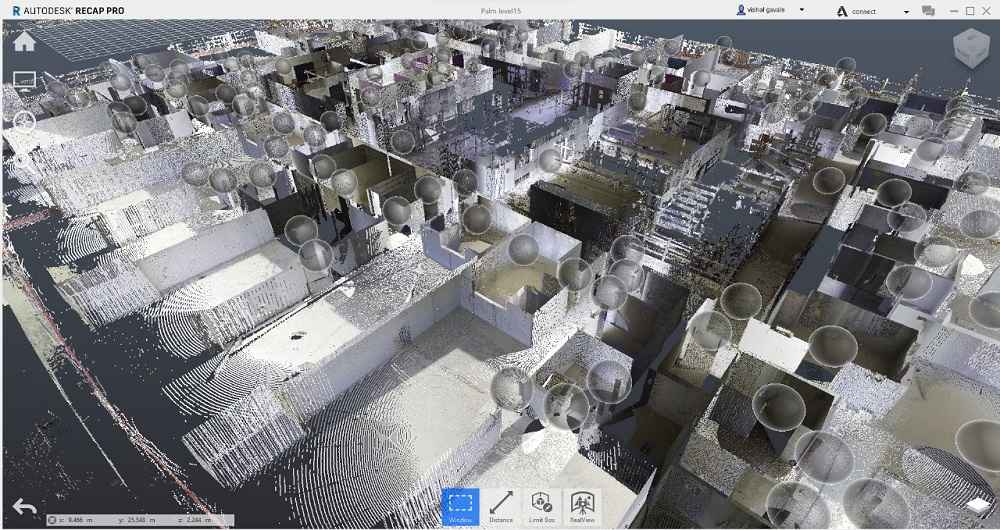
A collection of data points called a point cloud is used to represent a real-world object or space.
Millions of little measurements, each with an x, y, and z coordinate, combine to form point clouds.
Once a point cloud is created, it can be converted into a mesh or 3D model for further use.
Scan to 3D Models and scan to cad demonstrate precise and exact details—making point clouds a reliable way to capture as-built conditions.
Point clouds are recorded generally in two ways:
- Photogrammetry
- Laser scanning
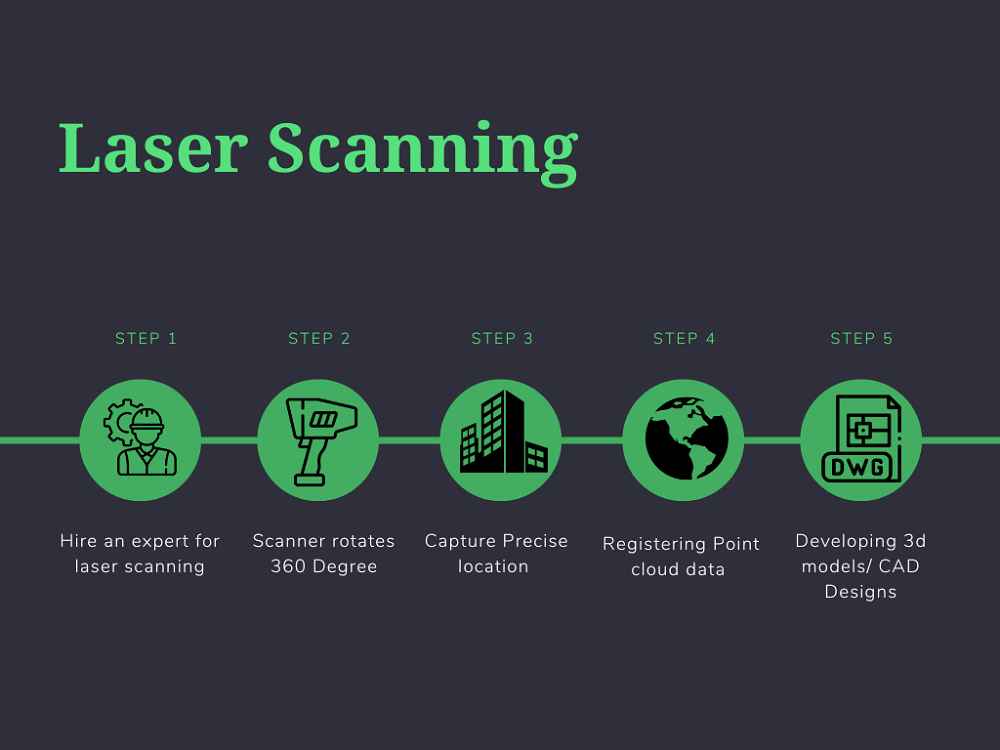
The best method of producing a point cloud is laser scanning:
- Hire a professional laser scanner with significant experience in point cloud scanning.
- A laser beam is used by laser scanners to record digital data about an object.
- The scanner is rotated 360 degrees to accomplish this, and surfaces in the scanning region are connected to the beam.
- The scanner then uses this data to record the precise location of objects in relation to their own position.
- The speed and degree of accuracy required for the majority of building documentation projects are provided by laser scanners.
The point cloud laser scanning process makes it simple for contractors to quickly access updated scan data as the project moves forward.
Top AutoDesk Revit Features for Efficient Point Cloud to 3D Modeling
For any efficient point cloud conversion to a 3D model, Autodesk Revit has become a popular choice in the industry due to its numerous built-in features which allow architects and professionals to create accurate and detailed 3D models. It also supports parametric modeling with ease along with real-time rendering and a myriad of collaborative tools that improve the whole workflow for everyone involved. It also introduces BIM in the whole process, adding time dimension and cost to the model, which allows scheduling and budgeting while allowing all stakeholders to coordinate and collaborate over a common platform.
There are a few advanced features in Autodesk Revit that can improve your scan to 3D model conversion efficiency:
- Point Cloud Visibility with Graphics Overrides: Revit allows its users to control and modify the visibility and graphical representation of the data through the Visibility/Graphics Overrides function. Point size, color and transparency can be changed helping users focus on relevant areas and model with clarity and accuracy.
- Point Cloud Alignment and Registration: As point cloud data is processed in ReCap, Revit can be further used to align and register the data, manually or automated, to ensure they are positioned accurately within the project coordinate system. This geo-referencing is particularly beneficial for large-scale projects.
- Creating Revit Families: Along with Revit’s pre-defined families custom families can be created including parametric objects matching the real-world scans. This helps in creating data-rich components that can be replicated quickly and easily across the model, maintaining accuracy and consistency.
- Annotating & Tagging the Model: Revit provides extensive annotation features in both 2D and 3D formats. It helps in documenting the whole building with detailed images, comments, tags and labels. It ensures that everything is recorded, increasing the effectiveness and saving time in coordination.
- Third-Party Plugins and Automation: Apart from the features already included, Revit also allows its users to employ third-party plugins to achieve a better Revit model from point cloud. These tools can automate tasks like feature extraction, compare models for quality checks, simplify overly dense point clouds and much more.
Why is Point Cloud to 3D Model Conversion a technical game changer?
Point cloud to 3D model conversion is no less than a technical breakthrough in the AEC industry which changes entire workflows for architects and engineers with unprecedented precision and efficiency. Laser-scanned point cloud data ensures high geometric accuracy, allowing exact replication of physical spaces in Revit models – helping in better planning, designing, clash detection and renovation.
- The Point Cloud 3d modeling process has also made parametric modeling based on real dimensions much easier and more accessible. Moreover, it enhances interdisciplinary coordination offering a data-rich model which has all existing systems – architectural, MEP and structural, documented.
- 3D models from point clouds have exact true-to-site dimensions geo-referenced to a unified coordinate system, helping professionals minimize assumptions and redesign with confidence. Finally, using certain automated tools manual modeling time can be further reduced without compromising quality or level of detailing. All these technical advantages make scan to 3D model conversion a powerful and game-changing tool which delivers informed design outcomes.
Exploring the Benefits of Point Cloud to 3D Model Solutions
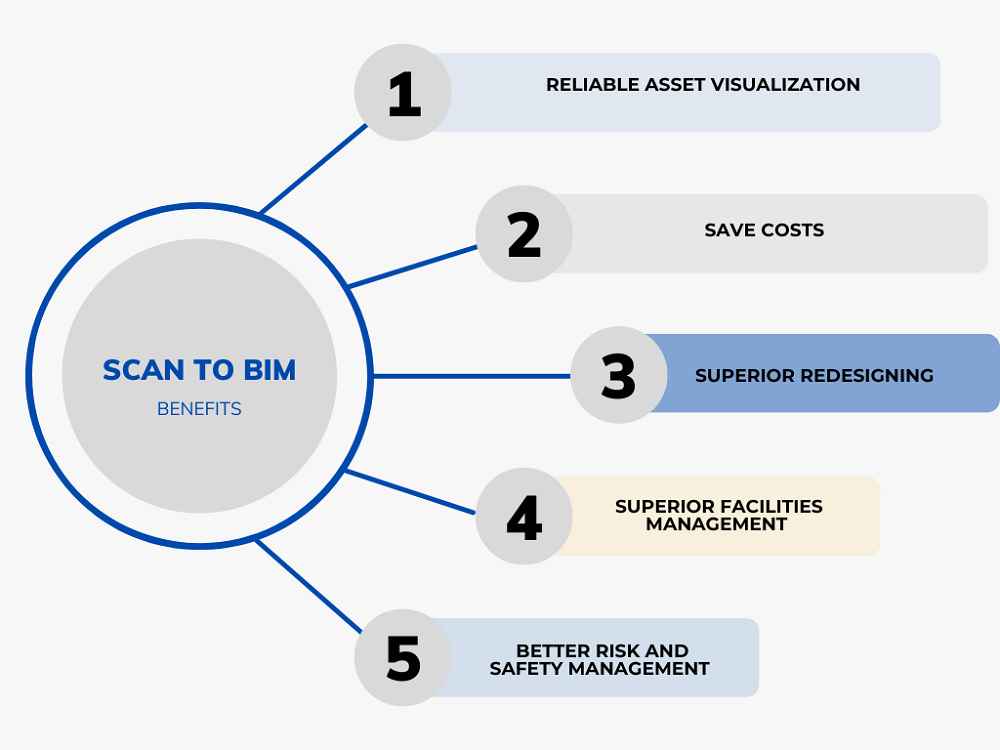
1 - Reliable Asset Visualization using Point Cloud to 3D Model
Information on buried building elements is displayed in a scan to 3D Model.
The complete examination of a building’s structure is made possible by the high-quality 3D model created using scanned data, which also aids project stakeholders in making decisions in a virtual setting.
Once a thorough model has been developed, this data reflects a level of detail appropriate for the work at hand to facilitate efficient concept visualization and communication among stakeholders.
2 - Save Costs using Point Cloud to 3D Model Services
Before construction, possible problems with building assets can be found using the Point Cloud to 3D Model. Such issues can be disclosed to clients and fixed before the project is implemented, which lowers redesign and cancellation costs.
Our team at CRESIRE has experience maximizing the operational performance of a wide range of physical assets, from schools to hospitals to residential buildings, by utilizing structured services like Scan to BIM to support successful handovers.
3 - Superior Redesigning for Renovation Projects using Point Cloud to 3D Model
Even if an asset has been modified or developed many years ago, it is typical for the full architectural blueprints and design drawings to be unavailable or outdated.
However, it is essential to have specific information about the structure in order to make better renovation options.
Engineers can use the scanned data for redesigning and 3D modeling thanks to convert Point Cloud into 3D Model Services, which gives photos of the skeleton of build assets.
4 - Superior Facilities Management using Point cloud to 3D model
Scan to BIM technology is most commonly used to create complicated geometry and the texture of buildings.
Building facility operations and facility management stages are additional times when the benefits of the scan to BIM modeling can be observed.
The BIM models generated using point cloud data are populated with as-built and lifecycle information of a built asset. Generally, such models are developed in a common data environment such as BIM 360, in which project stakeholders.
Better design documentation and usefulness are made possible by the Point Cloud data to 3D Model technology.
In order to enhance building performance, energy consumption, and structural dependability, performance analysis of the building is also put into practice.
5 - Better Risk and Safety Management using Point cloud to BIM
Using point cloud data, project stakeholders can locate the issues and challenges in the existing site. Developing a scan of the BIM model further improves the process by modeling the design details in a three-dimensional environment.
Construction Managers can point out the potential design risks in the Revit model that can be added to the risk register.
This can be useful for enhancing construction safety management, recognizing safety risks, and determining how safety can be guaranteed.
6 - Extracting Accurate Dimensions using Point cloud to 3d model
The 3D point cloud scans demonstrate real-time conditions of the site. Additionally, it aids in your comprehension of how the various structural components are related spatially.
Using point cloud data helps architects and engineers to avoid measurement errors as they are able to access the exact site dimensions. This helps them to conduct precise scan to 3d model conversions.

Get FREE Quote
For BIM Services for Your Project
Conclusion
Developing and disseminating knowledge in a digital environment is quickly replacing decision-making in a 2D context, especially in the post-pandemic era.
Point Cloud to 3D Model, Scan to BIM Services, and Scan to CAD Services assist project stakeholders in improved decision-making and project management (s).
Many construction companies in developed countries leverage Scan to BIM Services, especially for renovation projects. This helps them to eliminate potential design risks, superior facility management, and develop accurate designs & 3D models.
Many people who work in the construction industry still don’t fully understand. They don’t understnad the uses and benefits of Scan to 3D Model services. As a result, not all construction businesses and sectors have fully embraced the use of Scan to BIM conversion services.
Point Cloud to 3D Models is quite useful for renovation projects. It provides great insight into a building’s architectural, structural, and MEP components details.
Create 3D model from Point cloud modeling helps AEC professionals to develop Revit models using laser-scanned data. Considering the major advantages and limited drawbacks, the future of Point Cloud to BIM looks quite positive.
It is important for construction professionals including contractors to be well acquainted with the point cloud scanning process. This can be achieved by conducting training sessions by the organization for employees and project stakeholders.
Our Recent Projects on BIM Services

Related Posts

Share Via
Tags

Devashish Sharma
Devashish is Founder/Director at Cresire where he leads BIM services. He holds a bachelor’s degree in Civil Engineering from the University of Sheffield and an MSc in Construction Project Management from The University of the West of England. His vision behind CRESIRE is to provide BIM services, adhering to best practices and procedures, to global customers, helping customers to save extensive production costs and overruns.
Recent Post
Our Services