Table of Contents
The Evolving Role of 3D BIM Modeling in Construction Delivery
A few years ago, many firms saw 3D BIM modeling as an enhancement to drafting. It improved presentations. It helped with coordination reviews. It added clarity to complex geometry. But it wasn’t always central to delivery strategy.
That perspective has shifted.
Across projects in the USA, UK, and Europe, 3D BIM modeling services now sit much closer to the core of project execution. The reason is straightforward: building systems have become denser, timelines tighter, and tolerance for error significantly lower. What used to be manageable on site is now too costly to correct after installation begins.
When structure, architecture, facade systems, and MEP services are competing for space within tight ceiling voids or constrained cores, interpretation errors multiply quickly. A coordinated model reduces that ambiguity. It gives teams a shared spatial reference instead of separate drawing packages interpreted in isolation.
Moving Beyond 2D Thinking
Traditional 2D workflows separate information logically, but they also separate responsibility. Structural drawings live in one set. MEP drawings in another. Architectural intent in another. Coordination often happens through overlay reviews and manual checking.
3D BIM modeling changes that dynamic.
Instead of asking whether systems should fit, teams can confirm whether they do fit. Spatial relationships become visible. Clearances can be measured directly. Installation constraints are easier to anticipate.
The practical outcomes often include:
- Fewer coordination-related RFIs during construction
- Reduced on-site modification of structural or service elements
- Clearer understanding of service zones and access requirements
- Earlier detection of structural–MEP conflicts
This does not eliminate redesign. But it moves redesign to the planning phase, where changes are less disruptive and less expensive.
The Impact on Construction Planning
Where 3D BIM modeling proves its value most clearly is during planning and sequencing discussions.
Contractors increasingly rely on coordinated models to study how work will actually progress. This includes reviewing:
- Structural steel erection sequences
- Slab pour phasing
- Crane positioning and material staging
- Temporary support systems
- High-density installation areas such as plant rooms or basements
When sequencing is visualized within a coordinated model, potential congestion becomes visible early. Trade stacking can be anticipated. Installation routes can be validated.
On high-rise or healthcare projects in particular, this level of foresight supports smoother execution. Site improvisation still happens, construction always carries unpredictability but the scale of unexpected conflicts tends to reduce.
Model-Based Quantities and Cost Predictability
Another area where 3D BIM modeling services influence outcomes is cost control.
Extracting quantities from coordinated models provides a different level of consistency compared to manual take-offs from fragmented drawing sets. When structural, architectural, and MEP components exist in the same environment, duplication or omission risks decrease.
The practical advantages include:
- More reliable quantity verification
- Improved alignment between design revisions and cost updates
- Reduced discrepancy between tender and construction quantities
- Stronger support for 5D workflows
In markets where material pricing fluctuates and project margins are closely monitored, this reliability carries measurable value.
Standards Matter More Than Software
Revit remains widely used across structural BIM modeling workflows because of its parametric structure and interoperability. However, software alone does not ensure coordination quality. The effectiveness of 3D BIM modeling services depends heavily on disciplined processes, such as:
- Clearly defined Level of Development (LOD) requirements
- Consistent naming and parameter standards
- Structured model federation routines
- Ongoing clash detection and issue tracking
- Independent QA/QC reviews
Without these controls, even advanced BIM platforms can produce confusion rather than clarity. Across the USA, UK, and Europe, projects increasingly reference ISO-aligned workflows to maintain consistency across distributed teams.
Outsourcing and Global Collaboration
Workload fluctuations are another reality shaping BIM delivery. Even firms with established internal BIM teams often encounter peak periods that strain resources.
Outsourcing 3D BIM modeling services has become a structured strategy rather than a reactive decision. When external partners operate within defined standards and communication protocols, they integrate smoothly into broader delivery frameworks.
The advantages typically include:
- Flexible scaling of modeling capacity
- Access to specialized structural or MEP modeling expertise
- Reduced internal overhead during non-peak periods
- Faster ramp-up for complex or multi-phase projects
Location matters less than process alignment. What determines success is clarity of standards and communication discipline.
3D as the Foundation of Broader Digital Workflows
It is also important to recognize that 3D BIM modeling is rarely the endpoint. It forms the foundation for:
- 4D schedule simulation
- 5D cost integration
- Sustainability analysis
- Asset data preparation for digital twin environments
If the base 3D model lacks accuracy or structure, downstream workflows lose reliability. For that reason, disciplined 3D modeling remains central to long-term digital construction strategies.
Conclusion
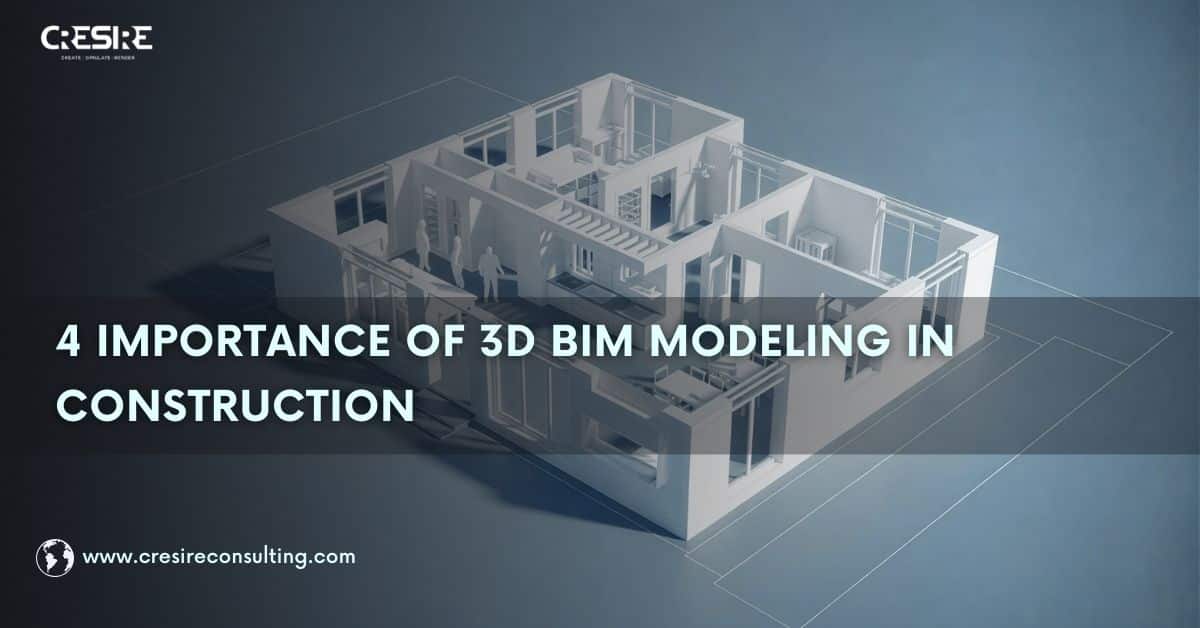
The importance of 3D BIM modeling in construction today is rooted in practicality rather than novelty. Buildings are more complex. Coordination tolerances are tighter. Stakeholders expect greater predictability.
A coordinated model provides a shared reference that reduces ambiguity across disciplines. It supports clearer planning, stronger cost alignment, and more structured decision-making.
Whether delivered internally or through experienced BIM partners, 3D BIM modeling services now influence not only how projects are designed, but how confidently they are executed.
In the current construction landscape, the digital model is no longer supplementary. It has become part of the operational framework of responsible project delivery.
Also read: How 3D Architectural Models Improve Design Visualization and Client Approvals

Devashish is Founder/Director at Cresire where he leads BIM services. He holds a bachelor’s degree in Civil Engineering from the University of Sheffield and an MSc in Construction Project Management from The University of the West of England. His vision behind CRESIRE is to provide BIM services, adhering to best practices and procedures, to global customers, helping customers to save extensive production costs and overruns.
Our Recent Projects on BIM Services

Related Posts